Pain Relief
Desk-Job Shoulder Pain: Stretches, Exercises & When to See a Massage Therapist in Madison
If your shoulders are creeping up toward your ears right now, read this before you try to force them back down.
I see desk workers all day at Resolution Therapeutic Massage in Madison. Software developers, state employees, grad students, customer service reps working from home in DeForest — the specifics change but the body complaint is almost always the same. Rounded shoulders. A tight band across the upper back. A headache that starts at the base of the skull.
It's fixable. But stretching alone usually isn't enough, and I want to explain why.
What's actually causing your hunched shoulders
When you lean forward at a screen for eight hours a day, your chest muscles (pectoralis major, pectoralis minor) slowly shorten. At the same time, your upper back muscles (rhomboids, middle and lower trapezius) get stretched out and weak because you're not recruiting them. This is called an upper-crossed pattern, and it's the most common posture issue I treat.
A few things can accelerate it:
Carrying a heavy bag on one shoulder
Holding a phone in one hand constantly
Chest-dominant gym workouts without balancing back work
Old neck injuries (whiplash, falls)
Being a student — especially in the Madison area where everyone is hunched over a laptop at a coffee shop
The reason pure stretching doesn't fix it is that you can't stretch your way out of a weakness problem. The tight chest is only half the story. The back muscles need to wake back up too.
Why it matters beyond looking slouchy
Clients come in for neck and shoulder pain, but the consequences of rounded shoulders reach further:
Tension headaches at the base of the skull
Shallow breathing — your rib cage literally can't expand properly when your chest is collapsed
Lower back compensation pain
Acid reflux, slower digestion
TMJ tension
Fatigue from poor oxygen intake
Most of my clients are surprised how much clearer they feel once we get things moving again.
Stretches that actually help (do these every day)
Start with three things. You can do all of them in under five minutes.
Doorway chest stretch
Stand in a doorway. Place your forearm against the frame at shoulder height, elbow at 90 degrees. Step your opposite foot forward until you feel a gentle stretch across the front of your chest and shoulder. Hold 30 seconds, switch sides. Repeat twice.
Foam roller thoracic opener
Lie on a foam roller placed lengthwise along your spine, from tailbone to head. Let your arms fall open to the sides in a T shape. Stay there for two to three minutes, breathing deeply. This reverses the hunch and reintroduces your upper back to the idea of extending.
Chin tucks
Sit tall. Without tilting your head, slide it straight back, as if pulling your chin into your neck to make a double chin. Hold for three seconds, release, repeat ten times. This strengthens the deep neck flexors and is one of the most underrated moves for forward-head posture.
Exercises that strengthen what's weak
Stretching opens; strength keeps it open. You need both. My top three for desk workers:
Band rows. Anchor a resistance band at chest height, pull toward your ribs, squeeze shoulder blades together. Three sets of 15.
Reverse flyes. Same band or light dumbbells, arms straight, lift out to the sides. Three sets of 12.
Wall angels. Stand with your back against a wall, arms in a goalpost shape. Slide arms up and down while keeping everything (lower back, shoulders, hands) touching the wall. Harder than it sounds. Three sets of 10.
Consistency beats intensity here. Five minutes a day will outperform a 45-minute session once a week.
When to bring in a massage therapist
If your chest and neck are already locked up, stretching can feel useless — you're fighting against tissue that's glued down. That's where focused bodywork makes a huge difference.
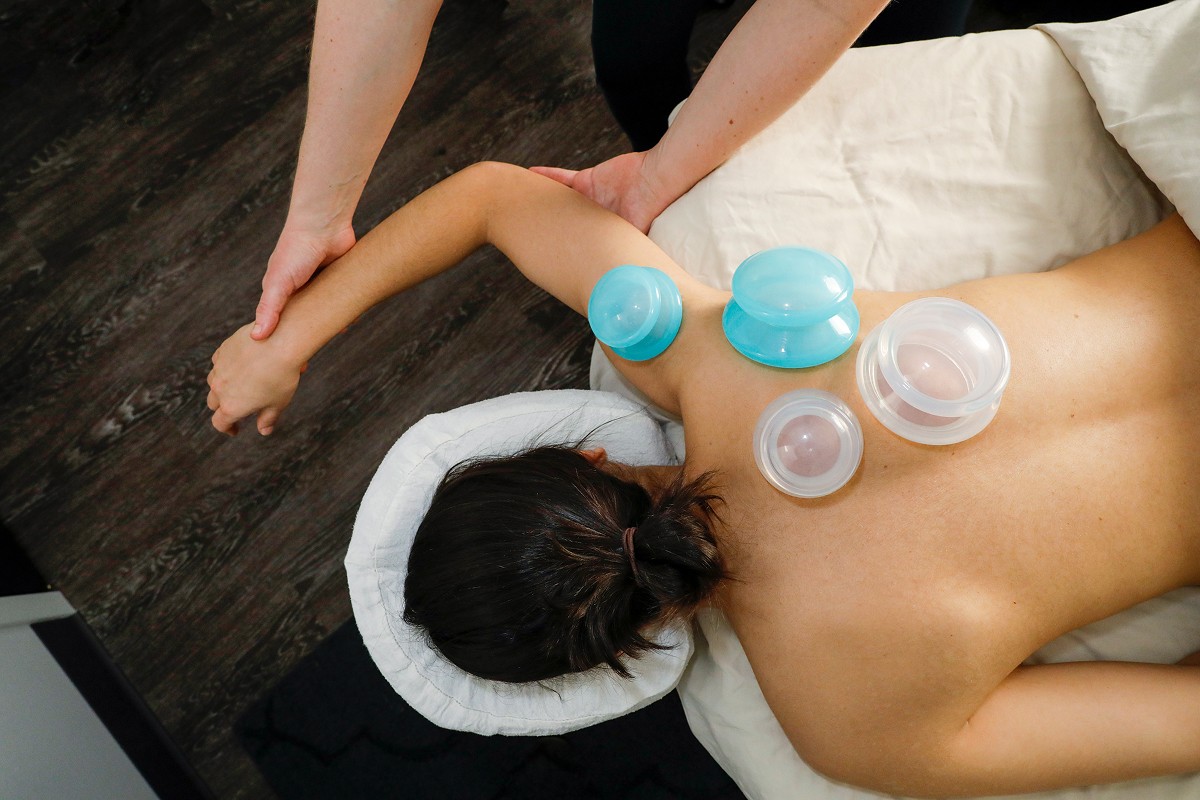
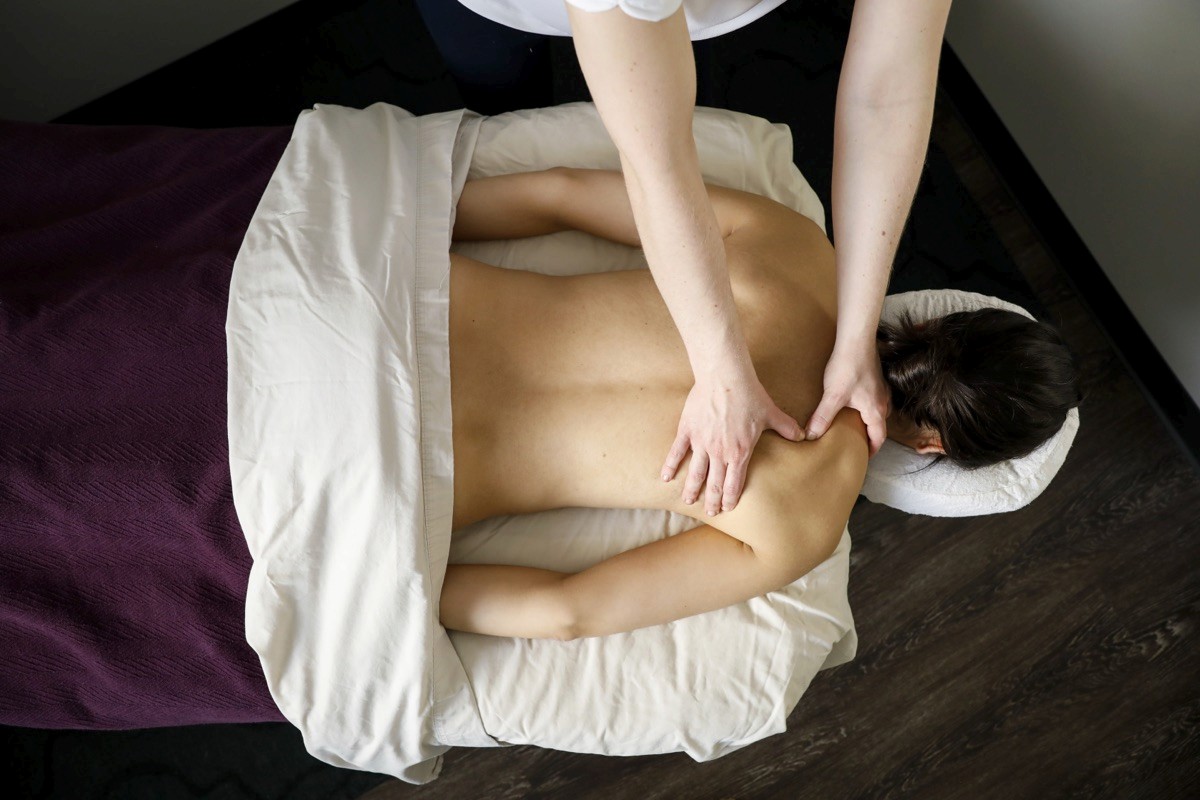
When clients come to me with this pattern, I usually work with a combination of deep tissue on the pectorals, myofascial release across the whole front of the chest and shoulders, and trigger point therapy on the upper traps, levator scapulae, and sub-occipitals — the little muscles at the base of your skull that cause so many headaches.
I'll also usually include some Thai-style stretching from the table. My training at the Naga Center in Portland was in traditional Thai massage, and I've found that passive assisted stretching plus manual therapy unlocks things faster than either alone. Once the tissue is released, your own stretching and strengthening work becomes much more effective.
Common questions
How often do I need to come in?
For an acute flare-up, I'd say weekly for three to four sessions, then spacing out to every two to four weeks for maintenance. For prevention with no active pain, once a month is plenty if you're also doing your stretches and strengthening work at home.
Should I see a chiropractor instead?
Honestly, a lot of my Madison clients see both. Chiropractors address alignment; I address the muscle and fascia tension that keeps pulling you back out of alignment. They work well together.
Can massage help if I've had this for years?
Yes, but it takes longer. The tissue has been adapting to bad posture for years, so we're slowly retraining it. I've had clients who thought this was just how their body was forever, and three months into consistent work they're standing up straighter without thinking about it.
Where can I get a massage for shoulder pain in Madison, WI?
I work at Resolution Therapeutic Massage serving Madison, DeForest, Waunakee, Sun Prairie, and the greater Dane County area. I specialize in deep tissue, myofascial release, trigger point therapy, and Table Thai massage for chronic tension and desk-worker posture. Book with me online or call 608-665-0392.